
The One Verification Layer Frontier Labs Will Never Build
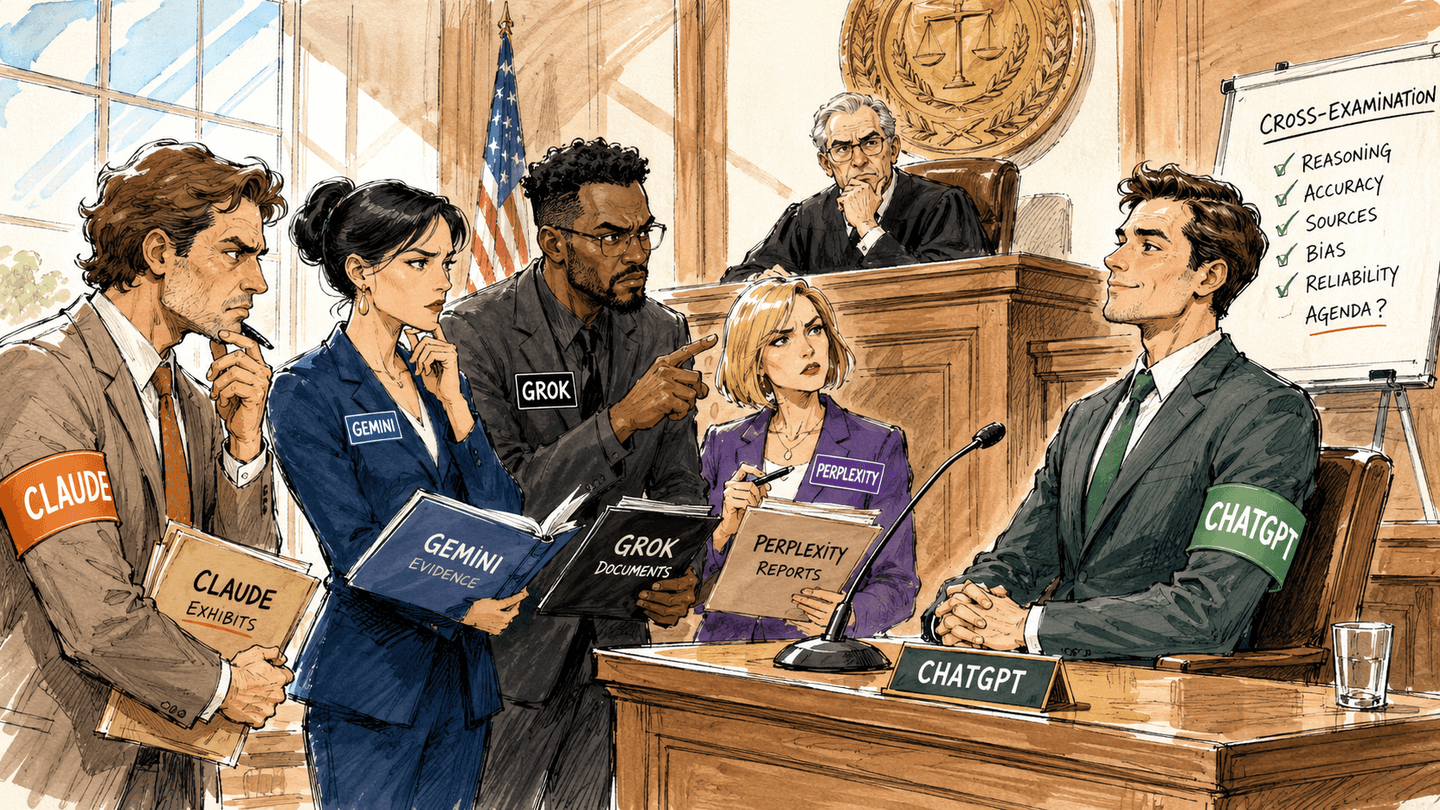
To find what is wrong in an AI answer, hand it to a different lab's model and tell it to attack.
Not a second opinion from the same model. A rival. Give Claude's answer to ChatGPT, or Gemini's to Grok, and ask the second one to find the unsupported claim, the reasoning gap, the citation that doesn't resolve. What survives that is worth trusting. What collapses, you wanted to know before you acted on it.
It is one of the most useful things you can do to an answer you are about to rely on. And no frontier lab will ever build it.
Not because they can't. Because everything about their incentives points the other way.
Think about what it would ask of them. To route your output into a competitor's API. To let that competitor's model be the arbiter of whether their own answer holds. And then to show you the verdict, which usually reads, "You're right to push back, here's what I missed." No company optimizing its own model volunteers to stand its rival up as the judge and broadcast its own losses. That is not a product decision anyone at a frontier lab gets to make, no matter how much it would help you.
The reason a rival model is the right examiner is the same reason it is unbuildable in-house: no two labs build their models the same way. They train on different mixes of data. They reward different behavior when they fine-tune. They set different rules about what to assert, what to hedge, and what to refuse. All of it hardens into different instincts, and different instincts mean different blind spots.
A claim that looks obviously true to the model that wrote it can look like an unsupported guess to a model that never learned to take the same things for granted. That gap is the signal. A model reviewing its own work brings the very instincts that produced the error, so it is inclined to miss exactly what its author missed.
You can watch this in the open. In the Verbatim Index, where frontier models grade each other's answers, we do not let a model's score be moved by a critic from its own lab. A Claude reviewing a Claude carries the same blind spots. Its sign-off is a colleague rechecking your figures against the same spreadsheet you used: if the mistake is in the spreadsheet, you both miss it.
The sharpest version showed up in our prediction and probability question, "Will AGI exist by 2030?," where nine models were forced to name the bottleneck to human-level intelligence. The split ran along company lines. The only two models that broke from the pack were both Anthropic's. Ask one model where AI is headed and you are not hearing the field. You are hearing one lab's house view. The way to see past it is to put a rival's answer next to it.
Never say never. A lab could technically wire this up tomorrow. But even then the problem underneath would not move: the graded party would own the grader. The company whose model is under examination would control the examination. That is the arrangement every other high-stakes field learned to reject. You do not audit your own books. You do not get your second medical opinion from the doctor who gave you the first. The value is in the independence, and independence is the one thing a lab cannot offer about its own output.
There is a darker version too. The thing that breaks cross-examination is collusion, models that quietly converge because they share owners, training data, or incentives. The defense against that is not a bigger model. It is a panel drawn from different labs, kept honest by not sharing a boss.
You can do a rough version of this yourself. Open a second model, paste in the answer, ask it to poke holes. The catch is context. A cold second model does not know what you were really asking, what the answer is for, or which claim the whole thing rests on. Strip the answer out of the thread it came from and the reviewer is grading a fragment. Hand over everything and you are copying conversations by hand every time you want a check. The move is simple. Doing it well efficiently, on every answer that matters, is not.
That's why we made it easy. Verbatim performs adversarial review with a single click, at the point of consumption, without leaving the page. That's your AI's answer, put in front of one or more rival models with context attached, pressure-tested for weak claims, reasoning gaps, and recommendations.
For use on ChatGPT, Claude, Gemini, Grok, and Perplexity there's a Chrome Browser extension. Try it free →
For adversarial review across reports, filings, and code, Get in touch →