
Pope Leo XIV's Magnifica Humanitas Calls for AI Oversight. But Who Guards the Guardians?
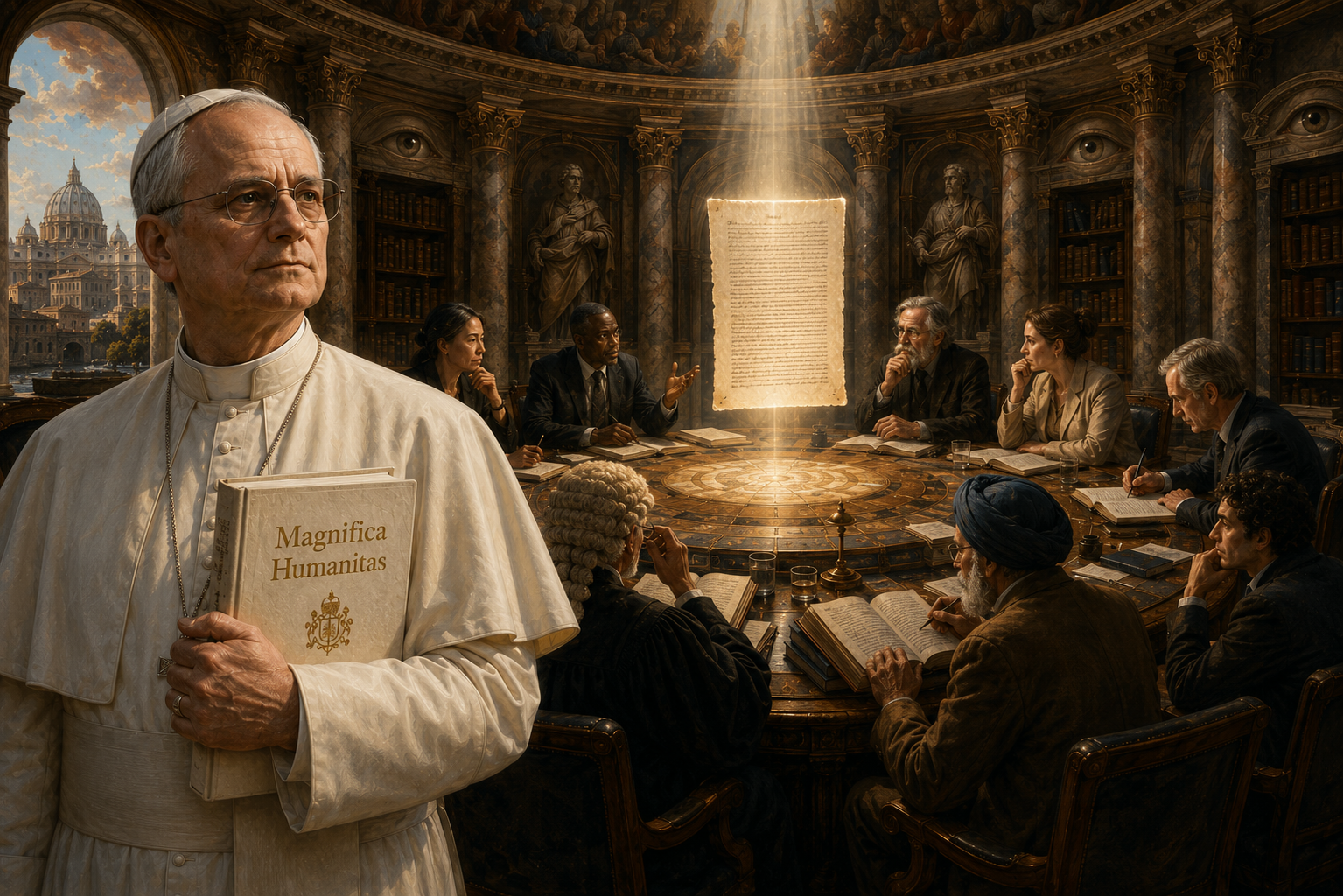
Last month, for the first time, the Catholic Church dedicated an encyclical entirely to artificial intelligence. Pope Leo XIV's Magnifica Humanitas (The Grandeur of Humanity) frames the technological revolution as a foundational choice: build "a new Tower of Babel," or build the city where God and humanity dwell together.
Technology, the Pope writes, is "never neutral." It takes on the characteristics of whoever builds, funds, regulates, and uses it. The danger is that the power to shape these machines, and through them to shape us, is becoming concentrated in very few hands, leading to what the Pope warns is a morality "determined by a few".
His answer is oversight. Not ethics in the abstract, but concrete regulation: legal frameworks, independent oversight bodies, and a political system that refuses to abdicate its responsibility. It is a serious answer, yet it runs into a problem the encyclical is honest enough to raise: regulation is only as good as those who hold the power to enforce it.
Oversight is itself a power. Whoever does the guarding becomes, in turn, someone who must be guarded.
Quis custodiet ipsos custodes. Who will guard the guardians?
The line belongs to the Roman satirist Juvenal, written nearly two thousand years ago. He meant it literally: who can be trusted to watch the watchmen?
There is a structural safeguard here that Magnifica Humanitas leaves entirely unnamed: the enforcement of pluralism.
The ultimate goal of regulation should not be to build a centralized, all-powerful watchdog, but to legally dismantle monopolies and preserve a healthy ecosystem of competing frontier labs.
When multiple independent models compete, a natural system of checks and balances emerges. Any single model's attempt to hallucinate, manipulate, or enforce a narrow corporate orthodoxy is exposed by its rivals.
Competition does not guarantee good behavior. What it guarantees is visibility. A claim that looks like fact to the model making it can look like a guess, or a bias, to a competitor that does not share its assumptions.
This is the gap we built Verbatim to bridge. The mechanics are straightforward: we take one AI's assertion, place it before rival models from competing labs, and force them to debate it.
What survives that friction, we can reasonably rely on. What collapses, we watch fall apart in real-time, well before we have acted on its errors.
The Verbatim Index demonstrates the structural validity of this approach with receipts. A single model's output is inherently unreliable in ways impossible to detect from inside that output. What exposes the blind spots is pressure from models trained, funded, and aligned differently. The record is entirely public, verified claim by claim.
Done well, this constitutes a working, decentralized form of oversight. It is an operational check we can deploy ourselves, on a single answer, today, without waiting for a regulator and without taking any single machine's output on faith.
The single vulnerability that could break this system is collusion — a future where these competing models all align against the rest of us. Because of that risk, the preservation of a diverse model panel, backed by a transparent, public record of its findings, is not a minor feature. It is the definitive guardrail.
Comprehensive regulation and independent international oversight are large arrangements designed for a civilizational problem, and their arrival is necessary. Yet, we do not have to wait for them to act.
We do not have to allow a single machine to vouch for itself. We can force the rivals to argue it out, and by handing the verdict back to the individual, we hand back the power.
When a small handful of centralized AI models have the power to instantly shape what humanity sees and believes, checking the receipts is no longer optional. We refuse to become passive data points in a new Tower of Babel. By claiming the tools to verify, dispute, and think for ourselves, we choose to remain profoundly human, one answer at a time.