
What Part of Your AI Workflow Is Responsible for Disagreement?
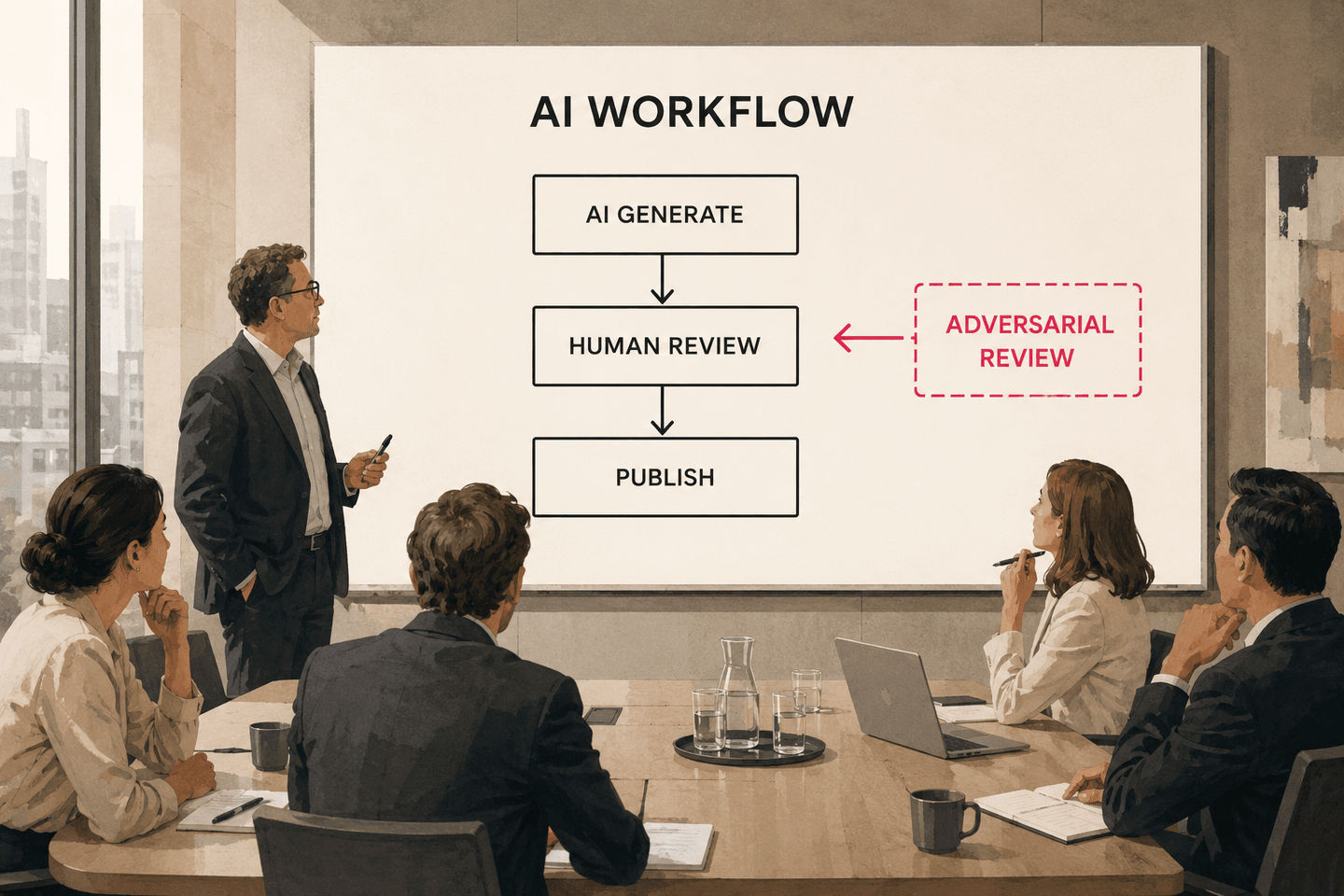
Most AI work does get reviewed. Someone reads it. It sounds clear, reasonable, well put together, so they move on.
That is the review. The check was whether the output sounded right. Then it becomes a decision.
This is the trap. AI produces confident, finished-looking work faster than any human process was built to check it. A model returns a clean recommendation in seconds. It reads as complete, structured, calm. Sounding reviewed and being reviewed are not the same thing, and from the outside they look identical.
This is not a problem of carelessness.
In the past week, KPMG pulled a report on agentic AI after organizations named in it, including UBS, the UK's National Health Service, and Transport for London, said its claims about their AI usage were untrue or misleading. Researchers who flagged the errors attributed them to AI hallucinations.
A firm of highly trained consultants appears to have used AI to help write a report about AI, and the unverified output went out under the firm's name.
Just last month, EY withdrew a separate report over what appeared to be fake footnotes.
These are not junior teams cutting corners. They are some of the most capable professional-services firms in the world, staffed by experienced people, with every incentive to get it right and reputations that depend on it.
That is the point.
The failure was not a lapse in competence. It was a gap in process.
The work was produced faster than it was checked, and the error surfaced not when the text was generated but when it was used, by which point it was already a published report under the firm's name.
Confidence is not review.
A confident answer has not necessarily faced a challenge. A polished paragraph has not necessarily survived a second point of view. A plausible analysis has not necessarily exposed its own assumptions.
If the output is going to become a client recommendation, a hiring call, a market claim, or a strategic memo, the question that matters is not "does this sound right?" It is "what tried to prove it wrong?" In most organizations the honest answer is nothing.
Human work is wrapped in verification by default: peer review, a manager's sign-off, the institutional memory of people who have seen this go wrong before.
AI output has none of that. It arrives finished and unexamined, and the speed that makes it valuable is the same speed that carries it past the point where someone would have caught the error.
The fix is not "use a better model." Every frontier model still hallucinates, and the newest one lowers the rate without taking it to zero. In high-stakes work the rate is not the standard that matters. The single wrong claim is.
The fix is also not "have a human check everything." That erases the productivity you adopted AI for, and it puts a lone reviewer in front of one confident output with nothing to push against. A person staring at a single fluent answer is poorly equipped to find what is missing from it. The assumptions are buried. The alternative reading is not on the page. The reviewer has to generate the counterargument from scratch, which is exactly the work the AI made them feel they could skip.
So, what part of your workflow is responsible for disagreement? Not editing. Not polishing. Disagreement. Who owns the moment the answer is forced to meet resistance before it becomes a decision?
This is the gap Verbatim is built to close. Not as a guarantee of truth, and not as a replacement for the person who signs off. As the thing that hands the reviewer the disagreement instead of making them invent it.
We take one AI's answer, put it in front of rival models from competing labs, and make them argue it out, so the assumptions, the weak claims, and the missing counterpoints are on the page before a human decides what to do with them.
The shift is small but it changes the workflow. Stop asking only what AI can produce. Ask what your process does after it produces it.
Before the next answer becomes a recommendation, a deliverable, or a decision, who is responsible for disagreeing with it?